

Breaking Ranks
The Lawmakers Who Dare to Defy Their Party
A recent analysis by Congressional Quarterly (CQ) confirmed what we have all been feeling: Congress is sharply more partisan now than in decades past.
Since World War II, CQ has been tracking what they call “party unity votes” – where the majority of one party votes against the majority of the other party. These include votes on legislation, votes for cabinet or judicial nominees, and even votes for Speaker of the House. As long as the majority of Democrats vote one way and the majority of Republicans vote the other, it’s a party unity vote.
In recent decades, fewer and fewer members have defected during party unity votes. When CQ first started tracking, members would vote with their party about 65-70% of the time. That number has steadily climbed; in 2024, members toed the party line in about 90% of these votes.
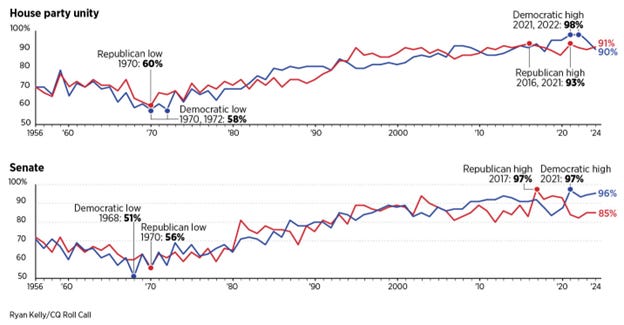
These votes are often the true test of courage. It’s easy to be the lone dissenter and symbolically vote against a bill that has near-unanimous support from both sides; it’s much harder to defect and join the other party in a hotly contested vote.
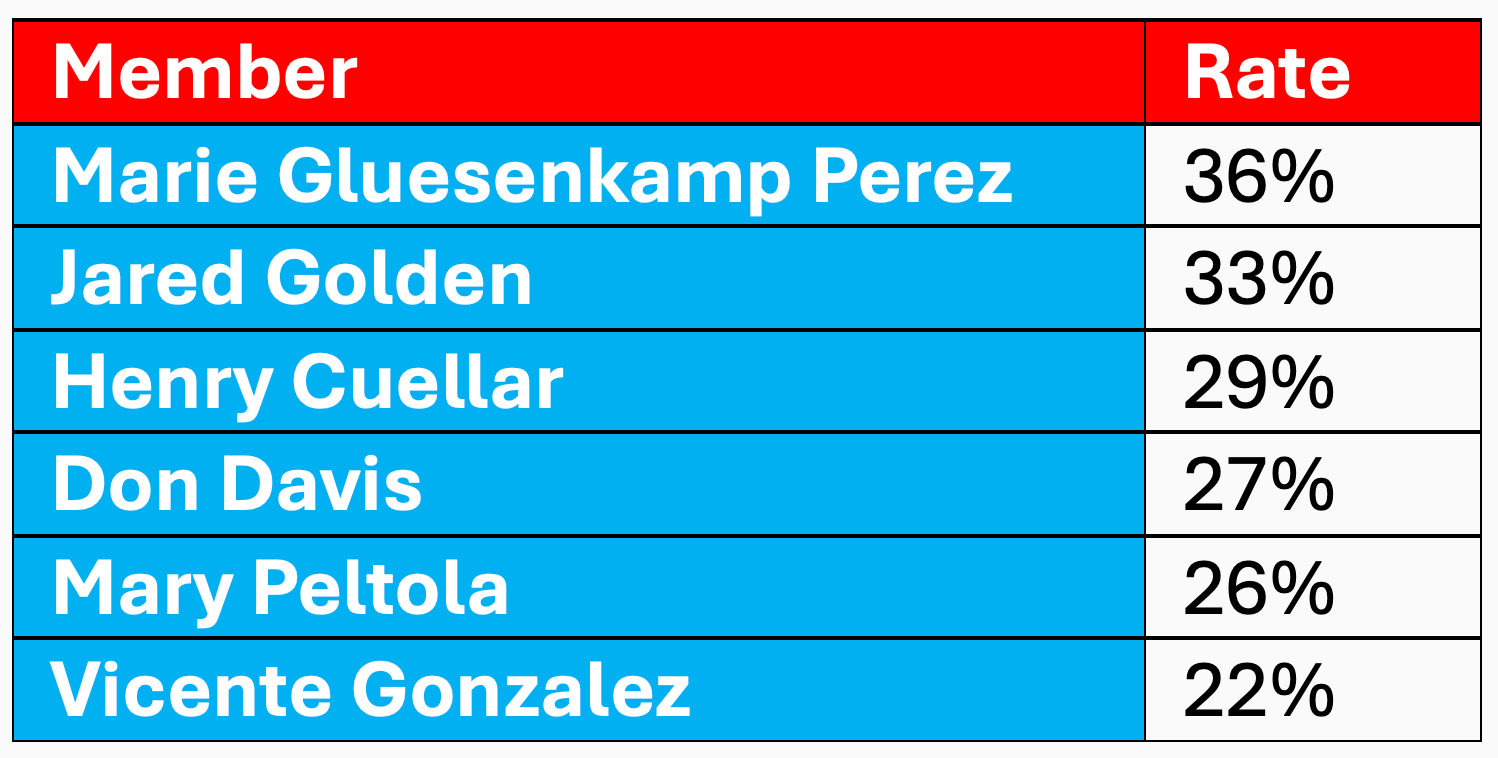
But rest assured, there are still some brave leaders in both the House and the Senate. Here is how often the most bipartisan House Democrats voted with Republicans last year:
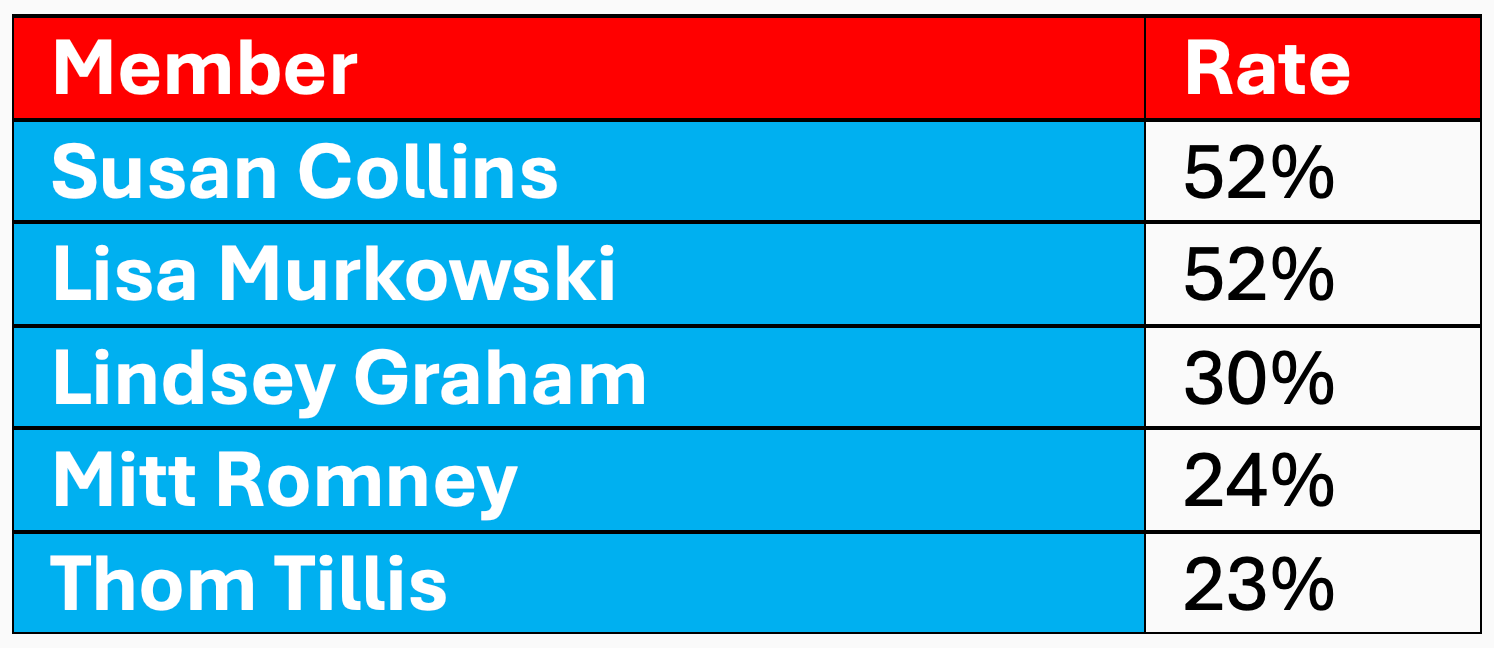
And here is how often the most bipartisan Senate Republicans voted with Democrats:
If you’re looking for pragmatic leaders who work across party lines when it counts, this is a good starting point.
Instead of resisting the Trump administration 24/7, brave Democrats like Reps. Marie Gluesenkamp Perez and Jared Golden have made clear they are willing to support commonsense legislation no matter which side of the aisle it comes from. And instead of rubber-stamping President Trump’s agenda, courageous Republicans like Sens. Susan Collins and Lisa Murkowski will stand on their principles, even when it draws the ire of the president.
It’s a shame that this courageous leadership is so rare these days. Washington needs to realize there is a middle ground between total resistance and total obedience to President Trump. That’s why No Labels’ work to support those who show courage is more vital now than ever.
Thanks - this is both maddening (the level of straight party-line voting) and inspiring (the few that are willing to buck that trend).
Is No Labels pursuing a strategy of targeting R senators who are either planning retirement (4 that I am aware of), over the age of 70 (operating on the theory they may be ready to retire, 12 by my count), or have terms beyond 2026? These folks might be more immunized to threats of being primaried and open to operating in a bipartisan way to help counter the most extreme parts of the Trump administration's agenda. I haven't looked at the counts on the D side but the same analysis would work.